2026.0722.001
Poster
Modulation of Visible and Near-Infrared Electrochromism in Donor–Acceptor Polymers for Smart Windows
Ammara Aslam • Silesian University of Technology, Gliwice
Event:
International Conference on Advanced Nanomaterials and Materials Science for Sustainable Energy, Electronics, and Future Technologies
International Conference on Advanced Nanomaterials and Materials Science for Sustainable Energy, Electronics, and Future Technologies
Type:
Conference
Conference
Published ID:
2026.0722.001
2026.0722.001
Abstract
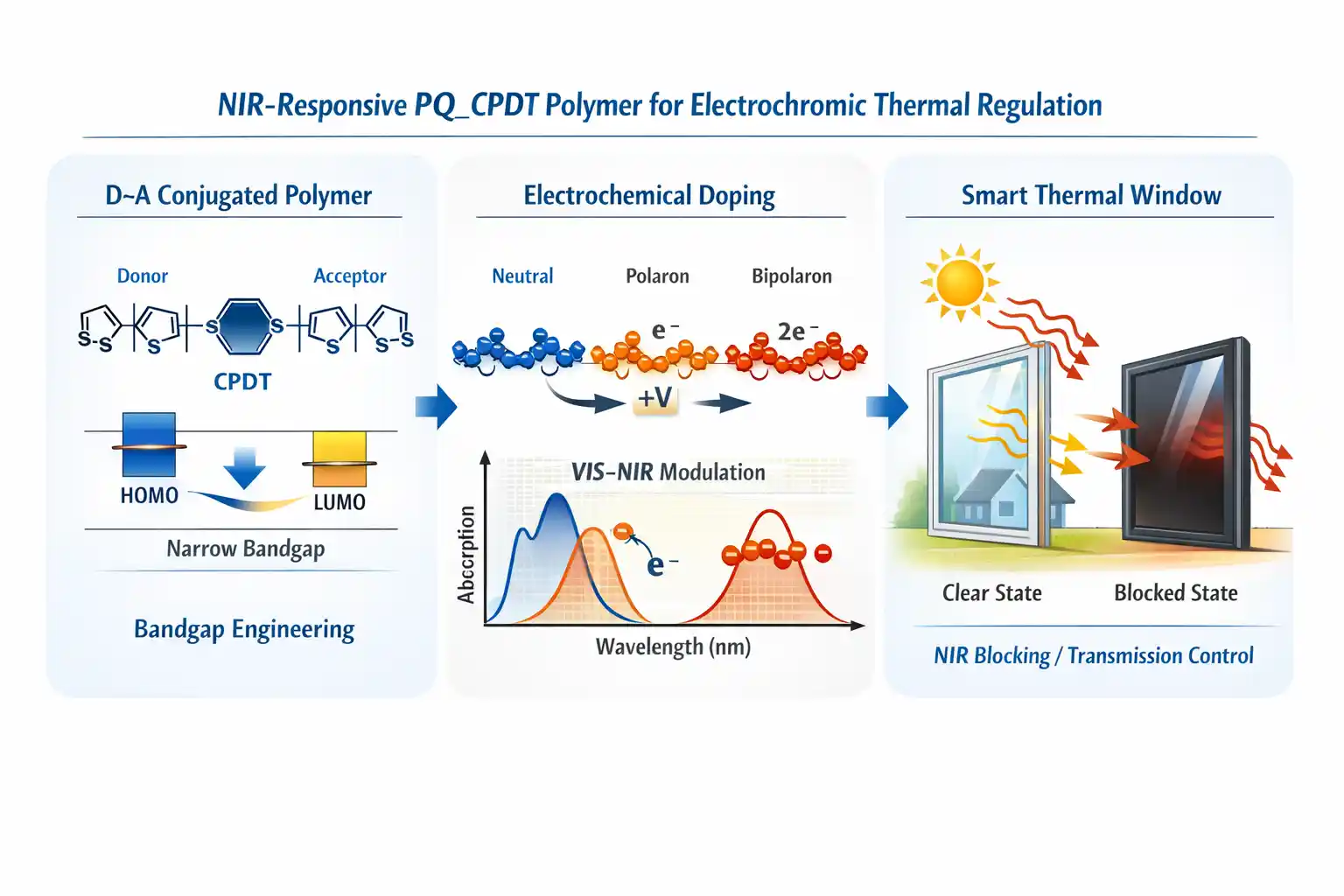
Conjugated polymers incorporating donor–acceptor (D–A) structures have emerged as promising materials for high-performance electrochromic devices due to their tunable optical bandgaps, broad color range, and excellent redox behavior. In this work, we present the design of a series of D–A polymers based on quinoxaline acceptor units and bithiophene donors, aiming to achieve narrow bandgaps for enhanced electrochromic activity in the near-infrared (NIR) region. The molecular design enables precise modulation of the highest occupied molecular orbital (HOMO) and lowest unoccupied molecular orbital (LUMO) levels, directly impacting the polymers’ optical transitions and redox behavior.
Spectroelectrochemical analysis confirms the reversible switching between neutral and oxidized states, with strong absorption differences in the NIR region. These shifts are attributed to the formation of polarons and bipolarons during electrochemical doping, resulting in a quinoidal distortion along the polymer backbone. The polymers exhibit excellent optical contrast and fast switching speeds. These results underscore the significance of structural engineering in D–A systems for developing efficient, NIR-active electrochromic materials suitable for applications such as optical filters and smart windows.
Spectroelectrochemical analysis confirms the reversible switching between neutral and oxidized states, with strong absorption differences in the NIR region. These shifts are attributed to the formation of polarons and bipolarons during electrochemical doping, resulting in a quinoidal distortion along the polymer backbone. The polymers exhibit excellent optical contrast and fast switching speeds. These results underscore the significance of structural engineering in D–A systems for developing efficient, NIR-active electrochromic materials suitable for applications such as optical filters and smart windows.
Graphical Abstract