2026.0722.003
Speaker
STUDY OF BIO-ORGANIC BASED NATURAL RUBBER THIN FILM AS A RESISTIVE SWITCHING MATERIAL
Muhammad Awais • Universiti Sains Malaysia
Event:
International Conference on Advanced Nanomaterials and Materials Science for Sustainable Energy, Electronics, and Future Technologies
International Conference on Advanced Nanomaterials and Materials Science for Sustainable Energy, Electronics, and Future Technologies
Type:
Conference
Conference
Published ID:
2026.0722.003
2026.0722.003
Abstract
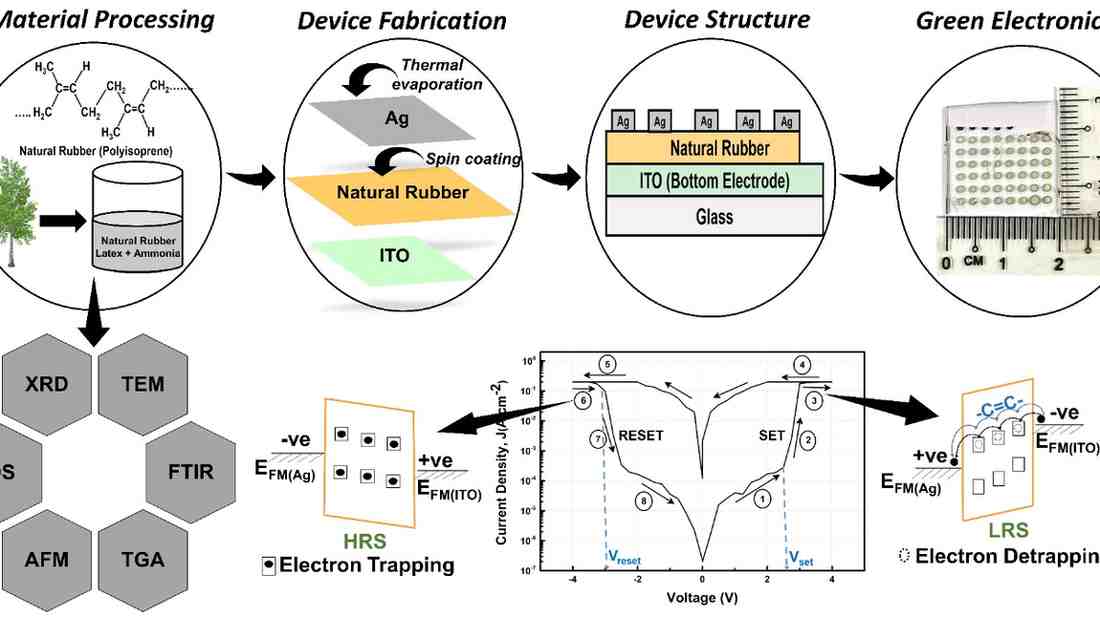
Green materials are now being used extensively in various electronic applications as a result of increasing environmental consciousness. Among them, bio-organic materials are attractive alternatives due to their natural biocompatibility, biodegradability and environmental friendliness. Bio-organic material is defined as material extracted from plant, virus, living, and/or once living thing that subsequently processed through a simple and environmentally friendly procedures to make it into a functional device. Here, a non-volatile memory device based on resistive switching in a bio-organic natural rubber thin film is demonstrated. Commercially purchased natural rubber latex was formulated and processed. A simple structure in which the natural rubber film is sandwiched between gold (Au) and indium tin oxide (ITO) as top and bottom electrodes, respectively, is used. From the current-voltage measurements, the device could demonstrate reproducible bipolar switching characteristics. Surface roughness, morphology and chemical functional groups were investigated via atomic force microscopy, scanning electron microscopy and fourier transform infrared microscopy, respectively. Current-voltage characteristics show that filamentary conduction is the primary conduction process in thin films made of natural rubber. The device can give competitive performance and has a high ON/OFF ratio at relatively low read voltage and wide read memory window, making it a promising candidate for next-generation non-volatile memory.
Graphical Abstract