2026.0722.007
Speaker
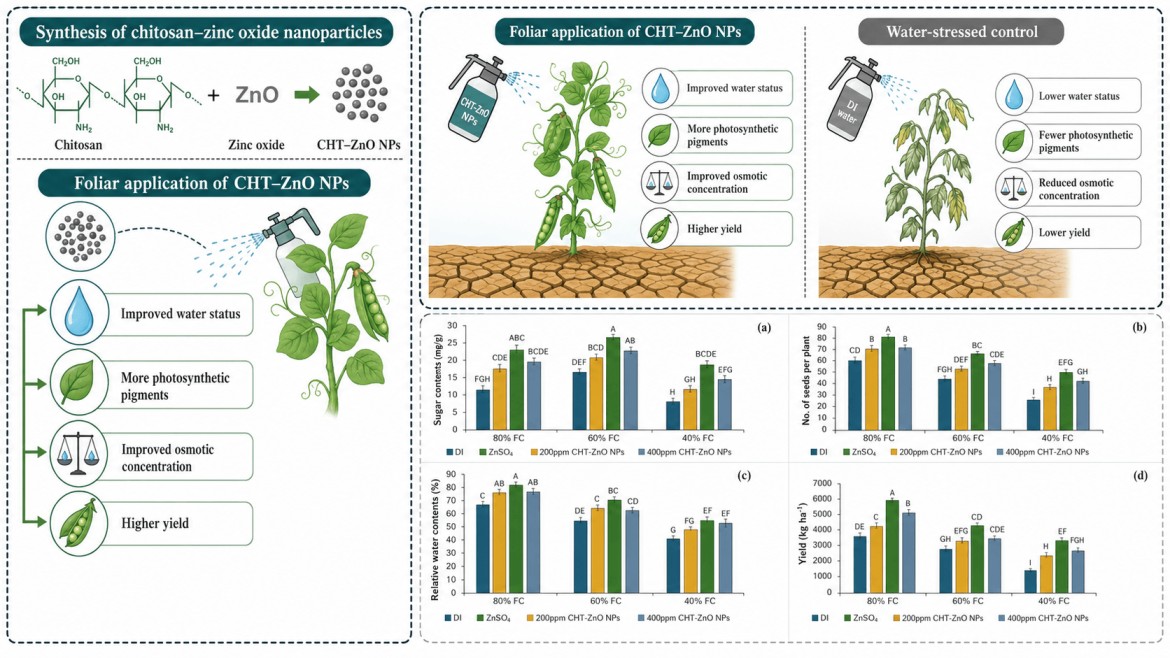
The foliar application of chitosan–zinc oxide nanoparticles improved pea yield under water-stress conditions by regulating photosynthetic pigments, plant water status, and osmotic concentration.
Aqsa Malik • University of Narowal
Event:
International Conference on Advanced Nanomaterials and Materials Science for Sustainable Energy, Electronics, and Future Technologies
International Conference on Advanced Nanomaterials and Materials Science for Sustainable Energy, Electronics, and Future Technologies
Type:
Conference
Conference
Published ID:
2026.0722.007
2026.0722.007
Abstract
Drought is one of the major environmental stresses that negatively affects crop growth and productivity, particularly in leguminous crops such as peas. This study evaluated the ability of chitosan–zinc oxide nanoparticles (CHT–ZnO NPs) to improve drought tolerance in Pisum sativum L. through foliar application. The nanoparticles were prepared using the ion-gelation method and characterized before application by field-emission scanning electron microscopy (FE-SEM), X-ray diffraction (XRD), Fourier-transform infrared spectroscopy (FTIR), and X-ray photoelectron spectroscopy (XPS). According to the designed treatment plan, pea plants exposed to different levels of drought stress were treated with CHT–ZnO NPs at concentrations of 200 and 400 ppm, as well as with ZnSO₄. The obtained results showed that CHT–ZnO NPs improved the physiological and yield-related characteristics of the plants under moderate and severe drought conditions. Among the tested concentrations, 200 ppm CHT–ZnO NPs produced the most noticeable improvement in chlorophyll content (42.8 to 31.9%) and overall yield (54.6 to 43.2%) compared with their corresponding controls under moderate and severe drought stress at 60 and 40% field capacity (FC), respectively. These results indicate that foliar treatment with CHT–ZnO NPs may provide an effective approach for reducing the harmful effects of drought and improving drought tolerance in pea crops.
Graphical Abstract